Your team tried AI. It looked fast until it wasn’t.
Now your designers are burning hours fixing hallucinated UI, your developers refuse to touch AI outputs, and clients are asking why they’re still paying premium retainers if “AI does everything.”
This isn’t an AI problem. It’s a workflow problem.
Most agencies didn’t fail because AI is bad. They failed because they plugged probabilistic tools into deterministic systems. And then wondered why everything broke.
If you want AI to increase margins without destroying quality, you don’t need better prompts.
You need a system.
The State of AI in Design Agencies: Speed vs. Quality
Why 61% of Agency Professionals Fear AI Commoditization
The fear isn’t irrational.
AI is compressing timelines. Clients are expecting faster delivery. And yes, junior execution is getting automated.
But here’s what most agencies get wrong:
They think AI replaces effort. Clients think AI replaces value.
If your workflow still looks like:
- Prompt → generate screen → polish → deliver
Then you’ve already lost the pricing conversation.
Because that workflow is commoditized.
The agencies winning right now aren’t faster. They’re more structured.
Why Generic AI Fails at Complex SaaS Workflows
Context Window Collapse and Hallucinated UI
You’ve seen this:
- Screen 1: clean, on-brand dashboard
- Screen 3: different spacing, new colors, random components
That’s not bad prompting. That’s how these models work.
They don’t understand systems. They redraw everything every time.
Result:
- Broken flows
- Fake data relationships
- Inconsistent UX logic
The Danger of Token Drift in Multi-Screen Flows
This is where most teams silently bleed time.
You fix a button → the layout shifts You tweak spacing → typography changes
That’s token drift.
And if you’re not actively preventing it, your designers become:
Full-time AI babysitters
If you want consistency, you need constraints like enforcing UI consistency through locked tokens (see: ai-ui-consistency-token-drift-workflow).
The Modern Agency AI Workflow: From Prompt to Production
This is where things actually start working.
Not hacks. Not tips. A real SOP.
Phase 1: Before Production (Context > Prompts)
Most AI failures happen before generation.
Fix that first.
- Aggregate research with AI
- Competitor audits
- Market analysis
- User sentiment
- Build a “shared brain”
- Store all research, interviews, and briefs
- Ensure every prompt pulls from project context, not generic data
- Lock your design system
- Color tokens
- Typography scale
- Spacing rules
No tokens = no consistency. Simple.
- Use structured prompting (CARE)
- Context
- Ask
- Rules
- Examples
Anything less = generic output.
Phase 2: During Production (Where AI Actually Shines)
Here’s the uncomfortable truth:
AI is terrible at ideation. AI is exceptional at production.
So stop using it backwards.
Flow-First Design: Prompting for Journeys, Not Screens
If you’re still prompting:
- “Design a dashboard”
- “Design a settings page”
You’re creating more work.
Instead, prompt:
- Full flows
- State transitions
- Edge cases
This is the shift toward flow-based design instead of static screens.
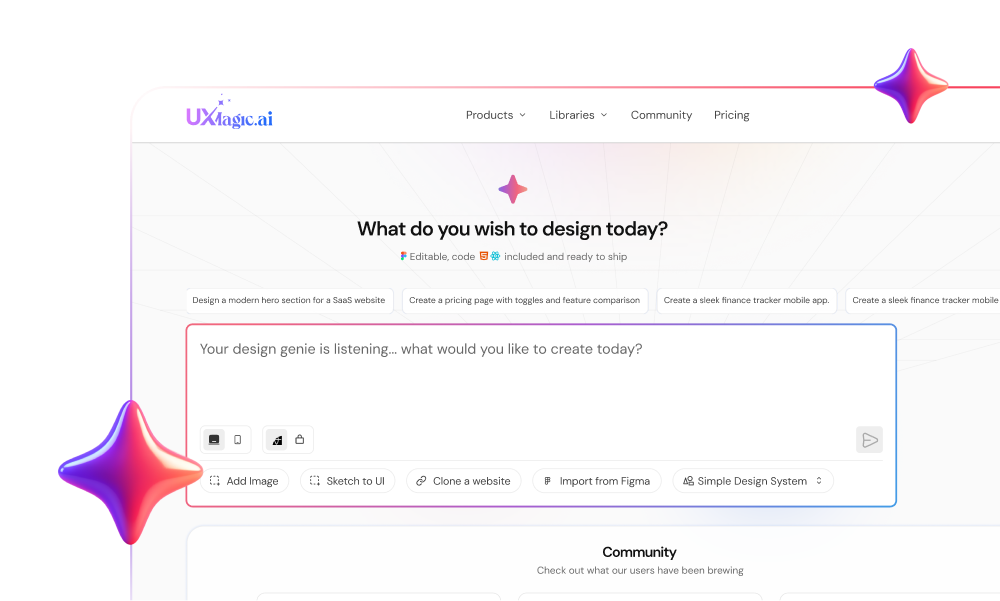
Tools like UXMagic’s Flow Mode exist for exactly this reason, it generates entire journeys with logic intact instead of disconnected screens.
Red-Teaming and Edge Case Mapping
Don’t trust the first output.
Break it.
Prompt:
- Failure states
- Error handling
- Empty states
Example: “Find 5 ways this flow can fail and generate UI for each.”
This is where AI becomes a real multiplier.
Sectional Workflows (Stop Regenerating Everything)
Never regenerate full screens.
Lock:
- Header
- Navigation
- Approved sections
Iterate only where needed.
This prevents:
- Layout collapse
- Token drift
- Wasted time
Managing the Developer Handoff: From AI UI to Real Code
Overcoming the Architectural Limitations of "Vibe Coding"
Let’s be blunt:
Vibe coding is not a workflow. It’s a demo generator.
It produces:
- No security
- No scalability
- No structure
And agencies trying to “fix” it are signing up for chaos.
The correct move?
Treat it as: A high-fidelity brief, not a product.
The Real Fix: Production-Ready Systems
If your AI output can’t translate to code, it’s useless.
That’s the handoff tax:
- Devs rebuilding everything
- UI bugs everywhere
- Timelines slipping
The solution is shifting toward creating production-ready UI systems without the tax (see: prompt-to-production-ai-design-workflow).
This is where logic-first tools (like UXMagic) matter:
- DOM-aware layouts
- React/HTML export
- Token-aligned components
Not “pretty screens.” Buildable systems.
How to Pitch AI-Augmented Design Without Discounting Yourself
Most agencies hide AI.
That’s a mistake.
Because clients already assume you’re using it.
Instead:
- Define what AI does (variation, mapping, speed)
- Define what humans do (strategy, QA, architecture)
Then sell this: We don’t charge for output. We charge for judgment.
Make it clear:
- AI increases volume
- You control quality
That’s how you protect retainers.
AI isn’t replacing agencies. It’s exposing which ones never had a system.
You can keep prompting screens and fighting inconsistencies.
Or you can architect a workflow where AI does the heavy lifting—and your team does the work that actually matters.
Choose carefully.
Stop fixing AI outputs. Start controlling them.
If your team is still stitching screens and cleaning up hallucinations, you don’t need better prompts, you need a system. UXMagic is built for flow-first, token-controlled, production-ready design workflows.