You tried it.
You pasted your token JSON into an AI tool. You told it to “use the design system.” It nodded politely… then hardcoded #1E3A8A into your button.
Now you’re burning credits, re-prompting like a maniac, and manually replacing inline padding: 18px with $spacing-md.
Here’s the uncomfortable truth:
AI can follow design tokens. But only if you architect your system and your workflow for machines, not humans.
If you don’t, you’ll pay the Unreliability Tax.
Why AI Fails at Design Tokens (And How to Fix It)
Let’s be precise.
Design systems are deterministic. LLMs are probabilistic.
Your token architecture requires strict alias mapping and scalable logic. LLMs generate the “most likely next token.”
That’s a fundamental mismatch.
Understanding Context Rot and Attention Dilution in LLMs
Large context windows are not infinite memory.
When you:
Dump multi-brand token libraries Keep 12 iterations of chat history Paste logs, diffs, and design feedback
You dilute the signal.
Your $color-surface-interactive rule is technically “in context” but it’s buried. The model takes the easier path: generate a hex code.
That’s context rot.
Fix:
- Aggressively prune conversations
- Re-inject the active token dictionary every turn
- Chunk generation by intent, not by screen
Never design an entire SaaS dashboard in one prompt. That guarantees hallucinated spacing and broken aliases.
The Danger of Vibe Coding and Technical Debt
“Vibe coding” works for demos.
It’s an architectural disaster in production.
When you throw natural language at a generic AI UI tool, it optimizes for:
- Visual approximation
- Immediate coherence
- Speed
It does not optimize for:
- Alias preservation
- Semantic routing
- Long-term scalability
So you get components that look correct but bypass your token system entirely.
Six weeks later, your design system update doesn’t propagate.
Now you’re refactoring AI-generated CSS across the codebase.
That’s not acceleration. That’s regression.
The 3-Tier Token Architecture for AI Systems
If your token system is flat, AI will fail.
Two-layer systems (primitives → components) are fragile.
AI needs a semantic translator.
Tier 1: Primitives (Hidden from AI)
Raw values:
$color-blue-600: #1E3A8A $spacing-4: 16px
Never expose these directly to the model. If you do, it will hardcode them.
Tier 2: Semantics (The AI Vocabulary)
Contextual meaning:
$color-brand-primary $color-surface-interactive
This is what AI should write.
Semantics act as a routing layer between visual output and business logic.
Tier 3: Component Tokens
Scoped overrides:
$button-primary-bg $button-primary-hover
These maintain scalability across states.
Without this structure, dynamic theming breaks instantly.
Naming Conventions: Making Tokens Machine-Readable
AI has zero intuition.
A vague name like:
$color-secondary
Is meaningless.
Instead, use:
$color-background-button-secondary-hover
Yes, it’s long.
Good.
That specificity removes ambiguity. It forces correct mapping.
If you’re still using human-friendly shorthand, fix that first. Then read our breakdown on how to name design tokens for scalability before introducing AI.
Managing AI Token Limits and The Unreliability Tax
The Unreliability Tax is simple:
If AI saves 30 minutes But costs 5 hours in QA You lost.
Here’s where the tax shows up:
- Hallucinated hex codes
- Inline CSS
- Fictitious spacing variables
- Fake package dependencies
- Broken semantic alias chains
And don’t ignore credit burn.
Endless prompting to “stop using raw hex” can wipe enterprise allocations in hours.
How to Reduce It
Before Generation
- Refactor to 3-tier architecture
- Clean token naming
- Connect via Model Context Protocol (MCP) if possible
During Generation
- Generate by section, not whole app
- Isolate the context window
- Monitor prompt token size
- Prune aggressively
After Generation
- Run deterministic validation scripts
- Flag:
- Raw hex
- Primitive usage in components
- Hallucinated tokens
- Flush AI memory
- Re-inject only validated state
This is systems engineering, not prompting.
UXMagic vs. Generic AI: Deterministic Style Guides
Most AI UI tools optimize for speed and visual approximation.
They use opinionated libraries. They hardcode defaults. They look impressive in demos.
But they crumble in governed systems.
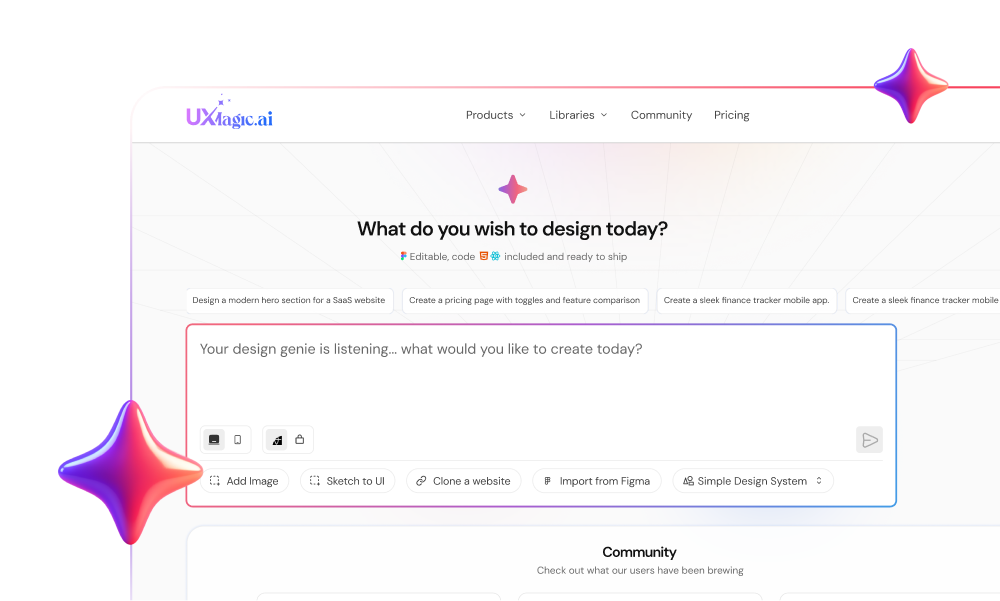
UXMagic approaches this differently.
Instead of freeform generation, it enforces:
- Strict style guide ingestion
- Machine-readable semantic layers
- Deterministic token mapping
When your design system is imported, generation is constrained by it. Not influenced by it. Constrained.
Sectional Editing: Killing Context Rot
Instead of bloating the model with an entire multi-screen app, UXMagic isolates a specific frame or component.
The AI processes only that bounded section.
Less noise. Less dilution. Higher token fidelity.
This is why intent-chunking works. If you want a deeper breakdown, compare UXMagic Flow Mode vs. chat-based AI to see how macro consistency is preserved.
Flow Mode: Macro Governance
While Sectional Editing handles micro-level precision, Flow Mode manages systemic coherence across screens.
If a semantic token changes in onboarding, it propagates.
No architectural drift. No state fragmentation.
That’s the difference between demo AI and production AI.
Ready to Stop Paying the Unreliability Tax?
If you’re serious about scaling UI with AI, stop treating prompting like magic.
Architect your tokens for machines. Chunk generation by intent. Enforce deterministic validation.
Or use a system built to do that for you.
Try UXMagic with your own design system and see what happens when AI is finally constrained instead of “guided.”
Because AI doesn’t need more creativity.
It needs boundaries.
Generate UI That Follows Your Design Tokens
Create consistent interfaces using your existing design tokens and system rules. Build faster with AI that respects your design system.