You’re not bad at prompting.
You’re just stuck in a broken workflow.
You ask for a “modern B2B dashboard.” You get a Dribbble clone. You tweak one component, and the AI redesigns your entire layout. You try a mega-prompt, and it ignores half your constraints.
At this point, it feels less like iteration and more like pulling a slot machine.
The real problem isn’t generative AI. It’s how we’re using it. If you’re treating AI prompt iteration like a one-shot design tool instead of a structured workflow, you’ll keep getting generic UI, broken design systems, and unusable handoffs.
Let’s fix that.
Why AI Prompt Iteration is Breaking Your Design Workflow
The Dribbble Clone Effect: Why Generic Prompts Fail
If every dashboard you generate looks like a dark-mode purple-gradient SaaS template, that’s not a coincidence.
Large Language Models (LLMs) are statistical averaging machines. When you say:
“Make it clean and modern.”
You’re mathematically asking for the mean of the internet.
And the internet is saturated with trend-driven portfolio layouts—not production SaaS environments.
If you don’t inject:
- Explicit design tokens
- Spacing systems (4px or 8px grid)
- Typography scales
- Data density rules
- WCAG contrast ratios
…you will get the statistical average.
Vagueness breeds the average.
Destructive Global Regeneration
You finally perfect your hero section.
Then you say: “Add a filtering sidebar.”
And the AI:
- Changes your brand hex codes
- Moves your nav
- Redesigns your buttons
- Breaks your component hierarchy
That’s scope explosion.
Standard chat interfaces don’t understand DOM boundaries or Figma layer isolation. Without strict constraints, the model rebuilds the entire context window from scratch.
That’s not iteration. That’s reset.
Context Window Amnesia in Multi-Page Flows
Page one looks perfect.
By page five:
- Border-radius rules drift
- Typography scale breaks
- Color tokens mutate
This is context window degradation.
Unless your AI is anchored to a persistent style guide or design token system, it will forget your foundation over time.
If your workflow relies on conversational memory, it will eventually collapse.
The One-Shot Fallacy
A 600-word mega-prompt is not advanced.
It’s cognitive overload.
When you try to force:
- Persona definitions
- Accessibility requirements
- Breakpoints
- Edge cases
- Full layout logic
…into a single execution block, instruction drop-off is inevitable.
Complex SaaS UI is sequential by nature. Your prompts should be too.
Prompt Design vs Prompt Engineering: Understanding the Difference
The industry keeps talking about prompt engineering.
That’s a backend discipline.
It focuses on:
- Token efficiency
- Context routing
- Latency
- Reliability
Designers need something else.
Prompt design is about:
- Emotional nuance
- Usability framing
- Constraint articulation
- Brand alignment
Engineers build the infrastructure.
Designers define how the AI should think about users.
If your prompts sound like terminal commands, you’ll get lifeless interfaces.
If they read like design briefs with strict structural constraints, you’ll get usable systems.
A Step-by-Step Workflow for Prompt Refinement in UI Design
This is where most teams fail.
They treat prompting as a single event.
Instead, use a three-phase operational framework.
Phase 1: Before Generation (Contextual Scaffolding)
Eliminate guessing.
- Clarify the functional goal
Bad: “Design a user settings modal.”
Better: “Design a user-role management modal for enterprise IT admins optimizing bulk permission updates.”
Shift from aesthetics to outcome.
- Assign a bounded role
Example: “Act as a Senior Principal UX Researcher and Data Visualization Expert.”
You’re narrowing the semantic reference frame.
- Inject baseline constraints
Specify:
- CSS framework (Tailwind, shadcn/ui)
- Grid system (4px or 8px)
- Typography scale
- Design tokens
- WCAG contrast expectations
This is the “librarian approach.” You define the library. The AI cannot invent one.
- Enforce output structure
Ask for:
- XML hierarchy
- JSON schema
- Structured React functional components
- Markdown tables
Unstructured output = messy handoff.
Phase 2: During Execution (Prompt Chaining + RSIP)
Abandon the mega-prompt. Use iterative refinement.
Implementing Prompt Chaining for Complex Components
Example workflow:
Alpha Pass (Structure Only)
“Generate XML wireframe hierarchy for the checkout flow. Focus on order of operations. No CSS.”
Now you have architecture.
Component Pass
“Using the
You build modularly.
Utilizing Recursive Self-Improvement Prompting (RSIP)
After generation, append:
“Review this layout. Identify three inconsistencies in hierarchy, WCAG contrast, or touch target sizing. Output corrected version.”
Now the AI acts as its own QA.
RSIP dramatically reduces manual heuristic evaluation.
It turns generative AI into iterative validation.
Granular DOM Mutation (Avoid Global Regeneration)
Instead of: “Improve the pricing section.”
Try: “Modify this pricing card only. Change CTA to ghost button. Reduce padding by 4px. Do not alter surrounding layout.”
Localized mutation prevents architectural destruction.
This is how human design directors work. AI should work the same way.
Phase 3: After Generation (Governance + Handoff)
If you stop at the PNG, you’re not shipping.
You must:
- Map generated styles back to official design tokens
- Refactor into modular React components
- Add JSDoc prop documentation
- Export clean auto-layout Figma files
Iteration isn’t done until engineering can implement it.
If you care about real handoff, read our guide on exporting clean Figma-to-React components, it closes the loop between generative UI and SDLC reality.
How to Build a Scalable AI Prompt Library for Your Team
Treat prompt sequences as intellectual property.
Organize by scenario:
- B2B dashboards
- Error states
- Mobile checkout flows
- Research synthesis
Not by tool.
Key principles:
- Save validated prompt chains
- Extract variable parameters
- Integrate via Slack commands or IDE shortcuts
- Make reuse faster than rewriting
If accessing a proven prompt is harder than typing a naive one, adoption will fail.
Codify success. Standardize iteration.
Moving from Chatbots to Canvas: The Power of Agentic AI
Standard chat interfaces are hostile to spatial UI workflows.
You’re constantly:
- Copy-pasting React code
- Re-rendering in CodeSandbox
- Mentally simulating layouts
That’s friction.
True iteration requires:
- Real-time DOM mutation
- Visual bounding of components
- Persistent style governance
This is where Agentic AI environments change the game.
With tools that support sectional editing for precise UI control, you can mutate a single component without global regeneration.
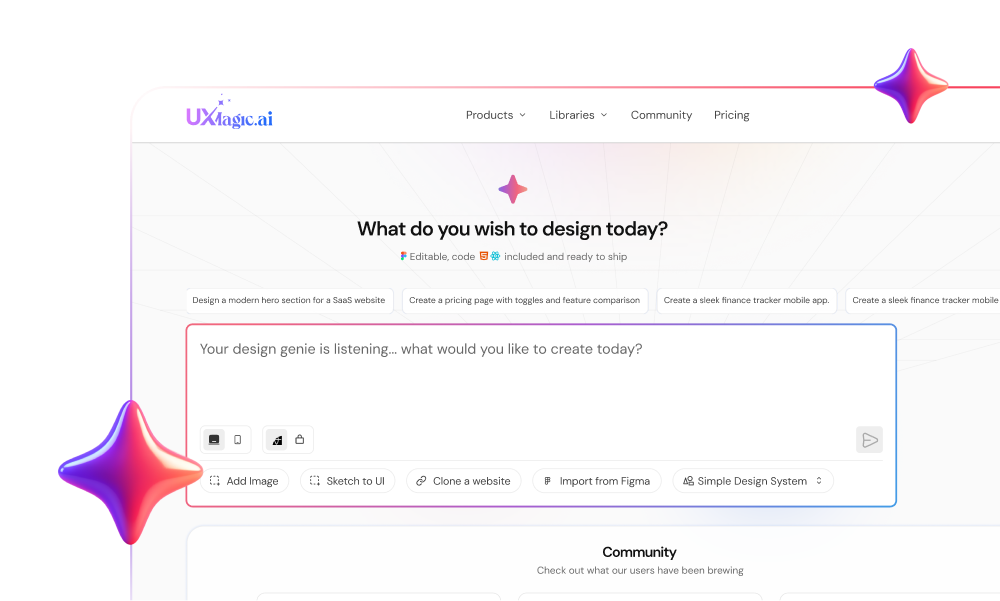
And with persistent style enforcement—like UXMagic’s Flow Mode—you prevent context window amnesia by anchoring all pages to a centralized design token system.
You’re not chatting with a model.
You’re directing an agent on a canvas.
That’s the difference between ideation and production.
The Real Shift
Stop asking: “How do I write better prompts?”
Start asking: “How do I build a repeatable AI design workflow?”
AI prompt iteration isn’t magic. It’s operational discipline. If you want predictable, production-ready UI and not pretty screenshots, Treat AI like a junior designer: Constrain it Chain it Critique it Govern it
And when you’re ready to move from chat-based chaos to structured, canvas-level iteration, start designing inside a system built for real SaaS teams.
Ship systems. Not slot machines.
Design UI That Actually Ships
Stop regenerating screens from scratch. Start building structured, editable UI flows that your team can ship. Try a workflow built for real SaaS products.