You finally get the AI to generate a beautiful screen.
Then everything breaks.
Change one button color and the entire layout regenerates. The navbar moves. The spacing collapses. The hero you refined for an hour disappears.
Welcome to regeneration roulette.
This is the reality many SaaS teams hit when experimenting with AI prototyping. The promise is speed. The result is often chaos: disconnected screens, fake dashboards, and prototypes engineers refuse to touch.
The problem isn’t AI.
The problem is how teams use it.
Senior designers and founders aren’t trying to generate pretty screens. They’re trying to compress the entire design-to-code cycle, from concept to a testable product flow—into a single day.
And that only works if the workflow changes.
The Evolution of AI Prototyping in 2026
From Static Wireframes to Agentic UX Workflows
Early AI design tools behaved like mood board generators.
You typed a prompt. You got a screen.
It looked impressive but it wasn’t usable.
The layouts were isolated. The components were inconsistent. The code was unusable.
That approach created three common problems:
- Screen myopia - every screen forgets the previous one
- Hallucinated functionality - dashboards with fake metrics
- Design drift - inconsistent typography, spacing, and tokens
Professional product teams now treat AI differently.
Instead of asking AI to generate screens, they ask it to generate system architecture and flows.
That shift turns AI from a design toy into a UX workflow accelerator.
Why “Speed to Market” Requires Parallel Experimentation
The biggest misunderstanding about AI prototyping is that it's about executing faster.
It isn’t.
The real value is testing more ideas at the same time.
Traditional workflow:
1 hypothesis 2 weeks of design 1 prototype
AI workflow:
3–5 solution directions Generated in one afternoon Tested with users immediately
This approach enables parallel experimentation instead of slow, sequential validation.
The result: better decisions, not just faster screens.
Bridging the Design-to-Code Gap for SaaS Teams
Eliminating Technical Debt in Rapid Prototyping
Fast prototypes are useless if they create engineering debt.
That’s the hidden trap of vibe coding.
AI can generate functional software quickly, but it often produces:
- fragile architecture
- inconsistent component structures
- security blind spots
- unmaintainable codebases
Many teams end up rewriting the entire product after their first MVP.
The fix isn’t avoiding AI.
It’s enforcing structured generation constraints.
Before generating UI, teams must inject:
- design tokens
- spacing scales
- typography hierarchy
- component libraries
Without those constraints, the AI invents styles randomly.
That’s how you get the dreaded “div soup” HTML exports.
Token-Based Architecture vs Flat Image Generation
This is where most AI tools fail.
Many platforms treat UI as images.
Professional workflows treat UI as structured data.
That means:
- tokenized colors instead of random hex values
- reusable components instead of flattened layers
- semantic DOM structure instead of generic divs
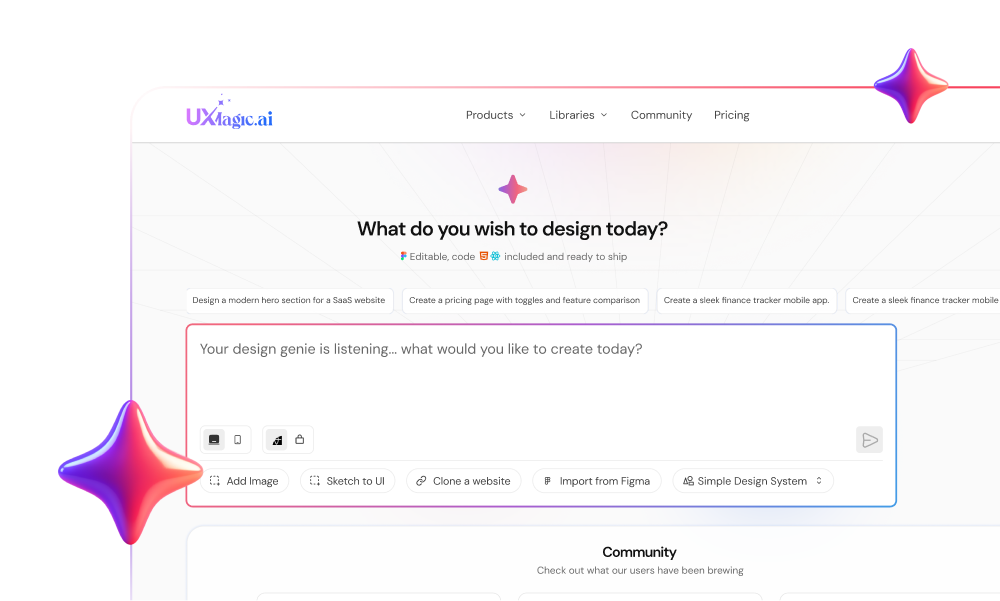
Platforms like UXMagic operate on this component assembly model. By importing an existing design system or Figma file, the AI generates layouts using predefined tokens instead of inventing new ones.
The result is a prototype engineers can actually build from.
Moving Beyond the Single Screen: Designing Flows
Preventing Design Drift in Multi-Step Journeys
Users don’t experience screens.
They experience flows.
Login → onboarding → dashboard → settings → errors.
Most AI tools generate these screens independently, which causes design drift.
Typical symptoms:
different button styles across screens inconsistent padding and layout grids navigation components changing unexpectedly
The fix is flow-based generation.
Instead of prompting individual screens, teams generate entire journeys.
Tools like UXMagic’s Flow Mode maintain structural memory across the sequence, cloning shared navigation components and preserving typography scales throughout the flow.
That prevents the Frankenstein prototype problem.
Non-Destructive Iteration with Sectional Editing
Another massive failure in AI design tools is full-page regeneration.
Real designers don’t work that way.
They adjust specific components:
pricing tables navigation menus charts onboarding forms
Professional AI workflows rely on sectional editing.
This allows you to highlight a specific UI area and modify it without touching the rest of the layout.
Example prompt: Convert this 4-column pricing table into a monthly/annual toggle layout and enforce the primary CTA token.
Only that section changes.
Everything else remains intact.
If you're interested in the deeper mechanics behind preventing design drift across flows, the UXMagic blog also explores this in its guide on flow-based design systems.
Handoff Mechanics: Exporting Production-Ready UI
Translating Prototypes to Semantic HTML and React
A prototype only matters if developers can use it.
Most AI tools export:
- flattened vectors
- poorly structured HTML
- unnamed layers
That creates a handoff crisis.
Developers must rebuild the UI from scratch.
A production-ready workflow should export:
- semantic HTML
- React component scaffolding
- tokenized CSS variables
- Auto-Layout compatible Figma files
UXMagic supports this via bi-directional synchronization, pushing structured prototypes back into Figma while also exporting React/Tailwind scaffolding for engineers.
Developers can then run:
- lint checks
- type validation
- visual regression testing
Instead of rewriting the UI layer entirely.
For teams looking to go deeper, the UXMagic blog also covers the Figma-to-React export pipeline and how semantic component structures reduce refactoring debt.
Real Scenarios Where AI Prototyping Changes the Game
Complex SaaS Onboarding
A fintech startup needs to test a KYC onboarding sequence:
- phone verification
- biometric authentication
- team invitations
- empty dashboard state
Traditional process:
- 2 weeks of design
- 2 weeks of engineering
- then user testing
AI workflow:
- Import design tokens
- Generate the entire flow sequence
- Hydrate with realistic data
- Test with users the same day
The next morning, developers receive semantic React scaffolding for implementation.
Refactoring a Data-Heavy Dashboard
A product manager wants to add predictive segmentation to an analytics dashboard.
Instead of rebuilding the UI in Figma:
- Capture the existing interface
- Highlight the chart container
- Prompt AI to replace it with a sortable data grid
- Preserve the surrounding layout
The change happens instantly without touching the rest of the architecture.
The Workflow That Gets You From Idea to Prototype in Hours
If you want AI prototyping to actually work, follow this structure:
1. Inject your design system first Import tokens, spacing, and components. 2. Generate flows, not screens Build connected journeys instead of isolated layouts. 3. Hydrate with real data early Stress-test the UI against edge cases. 4. Use sectional editing for iteration Avoid full-page regeneration. 5. Export semantic code for developers Ship prototypes engineers can build from.
This workflow eliminates weeks of boilerplate UI work while preserving the architectural discipline real products require.
Ready to Prototype an Entire SaaS Flow in Hours?
If your current AI tools are stuck generating disconnected screens, you’re using the wrong workflow.
UXMagic is designed for production-grade prototyping:
- token-enforced UI generation
- flow-based multi-screen design
- non-destructive sectional editing
- semantic React and HTML exports
Start generating real product flows instead of pretty mockups.
The teams winning with AI prototyping aren’t the ones generating the most screens.
They’re the ones testing the most ideas before writing code.
Speed isn’t about building faster.
It’s about learning faster.
Stop Vibe Prompting. Build Real Product Flows
Generate structured UI flows instead of broken screenshots. Use UXMagic to design with components, tokens, and real layout rules so your AI output is ready for Figma and engineering.