Your startup isn’t running out of time.
It’s running out of experiments.
Every extra week spent polishing a feature before validating it quietly destroys runway. But shipping half-defined UI flows is worse, it creates churn, support tickets, and design debt that compounds for years.
This is the real trap: teams think slow design protects quality and fast design protects velocity. In reality, both can destroy enterprise value if they’re done wrong.
The goal isn’t speed. The goal is sustained velocity without structural breakage.
Below is the framework modern SaaS teams use to stop shipping “page-shaped objects,” measure design impact in dollars, and move faster without poisoning their product architecture.
The Hidden Financial Cost of Slow Design in SaaS
Design delays don’t just slow releases. They reduce market share, burn capital, and distort product strategy.
Most teams underestimate how expensive “just one more iteration” really is.
How Design Debt Destroys Startup Runway
Design debt isn’t messy typography.
It’s fragmented navigation, inconsistent interaction models, and onboarding flows users abandon halfway through.
Unlike technical debt, which slows developers, design debt actively drives customers away.
Typical symptoms:
- mismatched button styles across flows
- inconsistent layout rules between steps
- missing error states
- navigation structures that shift mid-journey
- onboarding logic that assumes ideal user behavior
When these stack up:
- support load increases
- feature velocity drops
- onboarding activation collapses
- CAC effectively increases
- trust erodes
If your dashboard requires users to relearn interaction patterns every screen, your product is taxing their cognition and they leave.
Calculating the Cost of Delay for Feature Launches
Design timelines must be defended mathematically, not emotionally.
The simplest Cost of Delay (CoD) model:
Total CoD = Lost Month Cost + Peak Reduction Cost
Or more practically:
weekly projected profit × number of delayed weeks
Example:
If a feature generates $30,000 per week, a 4-week delay costs $120,000 before secondary market effects even begin.
This changes how decisions get made.
Suddenly:
- pixel polish becomes expensive
- scope creep becomes visible
- iteration loops become measurable risk
Design stops being aesthetic work. It becomes capital allocation.
Why “Move Fast and Break Things” Fails in B2B UX
Speed-only strategies worked for early social platforms.
They fail in modern SaaS.
Breaking a news feed is recoverable. Breaking RBAC permissions or billing logic destroys trust permanently.
The Churn Risk of Shipping Page-Shaped Objects
A page-shaped object looks complete in reviews but collapses in real usage.
It’s usually missing:
- edge-case logic
- transition mapping
- empty states
- permission visibility rules
- recovery paths
Developers then guess the missing behavior during implementation.
That guesswork becomes production bugs.
In B2B SaaS, broken flows don’t generate feedback. They generate churn.
The Logic-First Workflow: Speed Without Compromise
Fast teams don’t draw screens first.
They define system behavior first.
This workflow removes aesthetic debate early and replaces it with measurable decisions.
Phase 1: Pre-Design (Logic, Economics, Constraints)
Most expensive design mistakes happen before Figma opens.
Start here instead.
Step 1: Metric Alignment
Define the business lever: Not: improve UX
Instead:
- reduce TTV below 5 minutes
- increase Day-7 retention from 25% to 35%
- raise activation rate
- reduce onboarding drop-off
Design exists to move metrics.
Step 2: RICE Scoring
Evaluate:
- Reach
- Impact
- Confidence
- Effort
Then remove feature bloat immediately.
Your MVP is smaller than you think.
Step 3: Cost of Delay Modeling
Put a price on waiting.
If one extra week costs $30,000 in lost opportunity, visual polish must justify itself against that number.
Most of the time, it can’t.
Step 4: State and Logic Mapping
Before visuals: map
- happy path
- edge cases
- empty states
- error recovery
- RBAC visibility rules
Structure before styling. Always.
Phase 2: Active Design (Assembly, Automation, Validation)
Now the designer becomes a systems architect. Not a pixel editor.
Step 5: Token-Based Architecture Initialization
Replace hardcoded values with semantic tokens:
- color.primary.action
- spacing.layout.large
This is exactly why teams eventually shift to a tokenized architecture to ensure scalable UI consistency across flows instead of maintaining fragile artboards.
Step 6: Agentic Flow Generation
Instead of drawing screens manually, generate connected logic flows from component libraries.
This eliminates disconnected UI artifacts and ensures continuity across journeys.
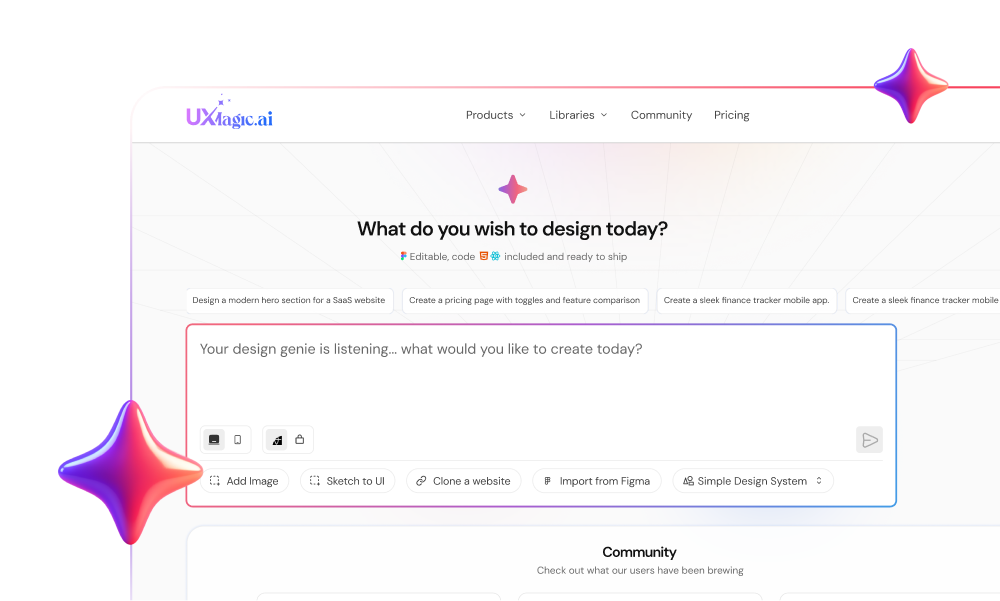
Tools built for this stage matter. For example, UXMagic’s Flow Mode generates multi-screen journeys from logic rather than isolated screens—preventing teams from polishing broken flows too early.
Step 7: Anchor Cloning for Structural Stability
Clone:
- navigation
- headers
- sidebars
- layout grids
Modify only dynamic content.
This prevents visual drift across steps automatically.
Step 8: Mandatory Logic Peer Review
Before visual polish:
review
- dead ends
- routing gaps
- inconsistent interaction states
- permission conflicts
Aesthetic feedback is irrelevant here. Logic first.
Phase 3: Post-Design (System Application and Handoff)
Only now should visuals finalize.
Step 9: Apply the Design System
Add:
- typography refinements
- micro-interactions
- brand styling
On validated structure only.
Step 10: DOM-Aware Code Export
Static handoffs create ambiguity.
Structured exports remove it.
Design becomes production-ready input not interpretation material.
Step 11: Metric Validation After Launch
Track:
- activation rate
- TTV
- drop-off points
- Day-7 retention
If metrics don’t move, redesign the logic not the color palette.
Overcoming the AI Hallucination Trap in Product Design
Most AI UI generators fail for one reason:
They treat interfaces like images.
Not systems.
Typical failure patterns:
- navigation changes across screens
- typography shifts mid-flow
- brand colors drift
- missing interaction states
- nonexistent components introduced
That’s not acceleration.
That’s rework.
This is exactly why teams avoid first-wave generators that produce disconnected outputs and instead rely on structured flow tools that prevent the visual drift and hallucinated UI common in early AI pipelines.
Leveraging Flow Mode for Structural Continuity
Logic-aware systems enforce reference-frame consistency automatically.
Instead of regenerating screens independently, they:
- clone anchor structures
- reuse component libraries
- preserve navigation models
- maintain token alignment
UXMagic does this by assembling flows from a repository of internally consistent components rather than hallucinating layouts from scratch so scaling a 15-step journey takes minutes instead of weeks.
That’s real velocity.
Frameworks for Measuring Design ROI and Velocity
Design arguments fail when they stay subjective.
Executives care about movement in business metrics.
Strong design teams track:
- Activation Rate improvements
- Time-to-Value reduction
- CAC efficiency gains
- support ticket drops
- retention lift
For example:
Reducing onboarding complexity can shift activation from 30% to 55%, directly lowering effective CAC.
This is exactly why teams increasingly focus on measuring onboarding redesign impact through activation metrics instead of defending aesthetic improvements in stakeholder reviews.
Design is not decoration.
It’s leverage.
Shipping faster doesn’t make startups win. Shipping coherent systems faster than competitors does.
Stop guessing where design is slowing your product down
Stop guessing where design is slowing your product down