If your product manager hands you a 40-page PRD and your first instinct is to skim it and start guessing in Figma, the system is already broken. Traditional requirements documents are where good design velocity goes to die. It is time to stop reading endless Google Docs and start generating testable UI flows directly from the raw requirements.
Most designers don’t actually want a definition of a product requirements document. They want a way to translate requirements into screens without wasting half a day drawing rectangles and chasing Slack clarifications. The real problem isn’t documentation. It’s translation.
In 2026, the PRD isn’t a contract. It’s a constraint engine. If you treat it like structured input for UI generation instead of a passive reference file, it becomes the fastest path from idea to production-ready flows.
Why the Traditional Product Requirements Document Is Broken in 2026
A traditional product requirements document was supposed to align teams. Instead, it usually creates translation debt between product, design, and engineering.
The biggest issue isn’t missing documentation. It’s unusable documentation.
Here’s what designers actually receive:
- vague instructions like “make it intuitive”
- bloated feature manifestos nobody reads
- disconnected acceptance criteria
- edge cases buried halfway down page 27
- Slack feedback replacing a source of truth
That combination guarantees rework.
A Carnegie Mellon Software Engineering Institute study showed 60–80% of software development cost goes into rework, and strong requirements management can eliminate up to 80% of project defects. Most teams ignore this because they treat PRDs as archives instead of inputs.
The Vague Requirement Trap
“Make it user-friendly” is not a requirement.
If it can’t be tested, it doesn’t belong in a PRD. Replace adjectives with constraints:
- load under 200ms
- checkout in two clicks
- WCAG AA contrast compliance
Anything else forces designers to guess interaction logic and then absorb the blame later.
If accessibility constraints are missing entirely, start with a structured approach like the one outlined in this guide on https://uxmagic.ai/blog/prompting-ai-wcag-22-accessible-ui
The Over-Engineered Manifesto Problem
A 40-page PRD rarely clarifies complexity. It hides it.
Most teams read maybe 10% of long requirement docs. The rest becomes silent assumption territory. Designers skim. Engineers interpret differently. Stakeholders disagree after implementation.
Shorter documents with explicit logic outperform longer documents with narrative filler.
If a feature needs more than two pages to explain, it probably needs decomposition instead.
Asynchronous Feedback Hell
Once a PRD turns into Slack comments, it stops being documentation and starts being noise.
Typical pattern:
- designer interprets PRD
- stakeholders respond asynchronously
- scope drifts silently
- engineering flags missing states
- redesign begins
Momentum disappears.
The fix isn’t more meetings. It’s generating flows early so ambiguity becomes visible immediately.
This shift is part of the broader transition described in https://uxmagic.ai/blog/ai-in-ux-design-workflow
The Blank Canvas Translation Tax
Reading a PRD and opening an empty Figma file is still how most workflows begin. That’s backward. You shouldn’t spend hours building layout scaffolding before solving logic problems. The smarter move is generating baseline architecture first, then editing systems instead of drawing boxes. If blank-canvas paralysis sounds familiar, this breakdown explains the pattern clearly: https://uxmagic.ai/blog/blank-canvas-syndrome-ai-ux-workflow
How to Read a Product Requirements Document Like a Senior Designer
Senior designers don’t “review” PRDs. They interrogate them.
The goal isn’t comprehension. The goal is extraction.
You’re looking for:
- functional requirements
- acceptance criteria
- edge cases
- backend constraints
- user stories
- failure states
Everything else is noise.
Spotting Vague Requirements and Defining Anti-Scope
Most PRDs include hidden anti-scope: statements that sound specific but aren’t actionable.
Examples:
- “fast onboarding”
- “simple dashboard”
- “clean navigation”
These are wishes.
Replace them with measurable rules before designing anything. Otherwise the system guarantees rework later.
Rejecting ambiguity early is faster than redesigning later.
Why You Must Demand Backend Feasibility Upfront
Designers who wait for engineering constraints design twice.
Designers who co-author constraints design once.
Before building flows, confirm:
- API limitations
- state transitions
- validation logic
- fallback behavior
- error conditions
This changes your role from executor to system architect.
Treating the PRD as collaborative infrastructure instead of a finished artifact is also central to the human-AI collaboration model explained here: https://uxmagic.ai/blog/human-in-the-loop-ai-design-workflow
The AI Workflow: From PRD to Production-Ready UI in Minutes
A product requirements document should generate flows not screenshots.
Modern workflows follow four phases.
Phase 1: PRD Interrogation
Start by extracting structure.
Pull out:
- user stories
- acceptance criteria
- logic gates
- edge conditions
- data schemas
Ignore adjectives.
What remains is a constraint dataset ready for generation.
This eliminates interpretation overhead before any visual tooling opens.
Phase 2: Bypassing Blank Canvas Paralysis with Generative AI
Traditional workflow: read PRD → open Figma → draw layout skeleton → guess states
AI workflow: read PRD → extract logic → generate flow baseline
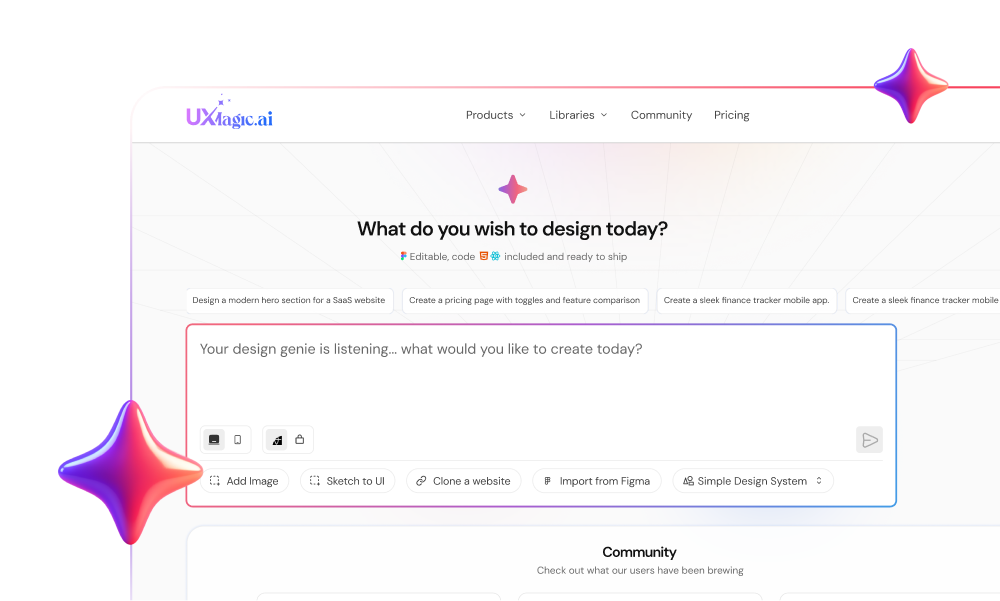
Instead of drawing containers manually, feed structured requirements into UXMagic and generate architecture instantly. Now you’re editing decisions, not constructing scaffolding.
That shift alone removes hours from early-stage design.
Phase 3: Using Flow Mode to Maintain Multi-Screen Consistency
Most AI tools generate isolated screens.
That creates a verification tax.
Navigation changes between frames. Typography drifts. tokens disappear, error states vanish.
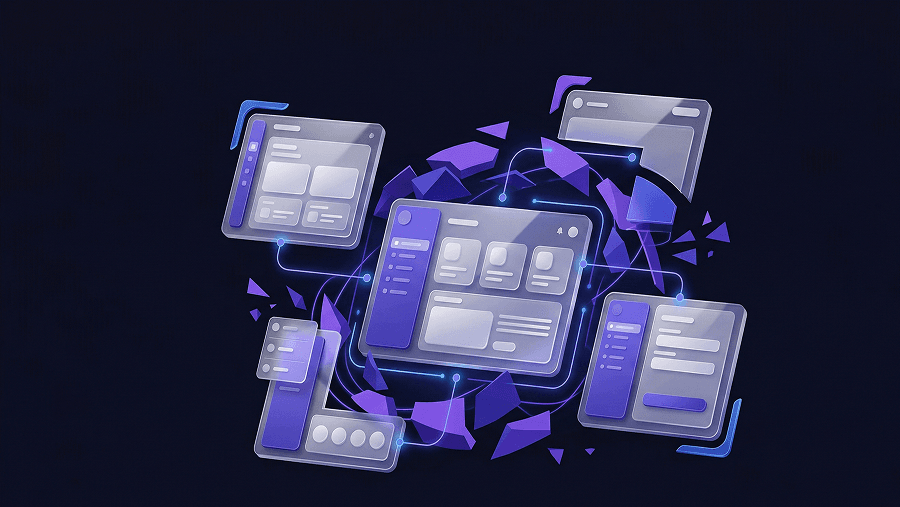
A PRD describes journeys, not pages. UXMagic’s Flow Mode keeps contextual memory across screens so component states, navigation logic, and structure remain consistent from step one to step four.
This turns generation into system construction instead of decoration.
If your tool outputs Dribbble-style fragments instead of flows, it’s solving the wrong problem.
Phase 4: Systemic Calibration and Edge Case Routing
Once the flow exists, your job changes.
You stop drawing.
You start editing:
- hierarchy
- spacing
- typography
- accessibility compliance
- edge-case routing
- interaction states
AI handles baseline layout. Designers handle system integrity.
That’s the correct division of labor.
Phase 5: The Handoff Without Translation Loss
Traditional handoffs fail because the design diverges from the PRD during iteration.
When flows originate directly from requirements logic, alignment improves automatically.
Because UXMagic exports code-aware layouts instead of flattened visuals, engineering receives assets that already reflect acceptance criteria and interaction structure.
The PRD finally becomes a shared source of truth again.
3 Common Design Handoff Mistakes (And How AI Fixes Them)
Most PRD-to-design failures repeat the same patterns.
Here are three.
Mistake 1: Ignoring Hidden Authentication States
Scenario: a SaaS team adds MFA.
PRD says:
“Users verify via SMS or authenticator app.”
Designer builds:
login screen + OTP field
Engineering responds:
missing recovery codes missing rate limits missing timeout behavior missing toggle states
Three-day delay.
AI-assisted workflow surfaces those missing flows immediately. Instead of guessing requirements, designers expose gaps before tickets reach engineering.
Alignment happens earlier.
Mistake 2: Generating Beautiful but Useless Dashboards
Scenario: analytics dashboard with complex filters and layered metrics.
Generic AI output:
- decorative charts
- fake data structure
- missing filters
- empty interaction logic
Visually impressive. Practically unusable.
When generation uses structured PRD logic and realistic mock datasets instead, hierarchy reflects actual data relationships.
That produces development-ready dashboards instead of portfolio screenshots.
If you still treat UI generation as styling instead of structure, revisit the fundamentals here: https://uxmagic.ai/blog/user-interface-design-guide-beginners-2026
Mistake 3: Treating AI Features Like Deterministic Flows
Scenario: adding an AI summarization agent.
Traditional workflow assumes linear navigation.
Reality:
AI output is probabilistic.
Design must include:
- fallback logic
- confidence indicators
- undo states
- tone guidance surfaces
- trust boundaries
When those constraints exist inside the PRD before generation, the interface supports variability instead of collapsing under it.
That’s the difference between designing around AI and designing with it.
Stop Pushing Pixels. Start Editing Systems
A product requirements document is not documentation. It’s architecture waiting to be visualized.
Stop translating requirements manually. Generate flows from them.
Stop treating PRDs as contracts. Treat them as prompts.
Stop drawing rectangles first. Define constraints first.
Try UXMagic free and generate your first multi-screen flow directly from a PRD in minutes.
Stop Reading PRDs. Start Compiling Them.
Feed your product requirements directly into UXMagic and generate structured UI flows before your kickoff meeting even ends.