Your pixel-perfect hero animation is stunning, and absolutely no hiring manager is going to see it. In 2026, nearly 80% of portfolios are parsed by AI screening before a human opens them. The first sentence of your UX portfolio matters more than your typography ever will.
Most designers are still optimizing for aesthetics. Recruiters are optimizing for proof of impact, role clarity, and constraint handling. If those signals aren’t visible in under a minute, your work disappears into the algorithmic void.
A strong UX portfolio in 2026 isn’t a gallery. It’s a compressed argument about business value, engineering empathy, and judgment under pressure.
Quick Takeaways: The 2026 UX Portfolio Directive
Pass the 5-second test via compression
Your homepage headline must instantly state role, domain expertise, and leverage.
Lead exclusively with the delta
Start with outcomes. Not wireframes. Not personas.
Highlight the messy middle
Show trade-offs, constraints, and failed assumptions.
Abstract your NDA constraints
Generate proxy UI flows instead of hiding your best work.
Stop documenting baseline process
Empathy maps and personas are assumed knowledge.
The 55-Second Rule: How Hiring Managers Actually Scan UX Portfolios
Recruiters don’t read portfolios. They scan them.
In 2026, the average review window is 55 seconds to three minutes. The first five seconds determine whether they keep going. That means your UX portfolio homepage has exactly one job: compress your usefulness into a single sentence.
Most designers fail this instantly.
Why ATS and AI Filters Are Rejecting Your Visuals
AI screeners don’t evaluate aesthetics. They evaluate structure.
If your portfolio opens with:
Product Designer | UX | UI
you’ve already lost. That headline says nothing about:
- domain expertise
- problem space
- operating range
- business leverage
A recruiter cannot categorize you. So they skip you.
A compressed alternative looks like:
Product Designer specializing in B2B SaaS onboarding and complex data workflows
Now they know where you fit.
That’s the role compression test.
And it’s mandatory.
If you’re unsure how designers are already adapting workflows around automation instead of fighting it, this breakdown of how designers actually use AI in real projects explains the shift clearly: https://uxmagic.ai/blog/ai-in-ux-design-workflow
Failing the Role Compression Test
Generic positioning signals junior uncertainty.
Specific positioning signals deployability.
Recruiters scan for:
- domain familiarity
- constraint exposure
- measurable outcomes
- collaboration depth
Not “creative thinking.”
Not “user empathy.”
Not “pixel perfection.”
Your UX portfolio is evaluated like infrastructure. Not artwork.
5 Toxic UX Portfolio Red Flags You Must Delete Immediately
Most portfolio advice still reflects the 2019 hiring market.
That advice is actively harmful now.
Here are the five fastest ways to trigger rejection.
- Leading With Empathy Maps
The fastest way to get your UX portfolio ignored in 2026 is to open with empathy artifacts.
Hiring managers assume you understand users.
They do not assume you understand:
- technical debt
- rollout constraints
- stakeholder negotiation
- system scaling
Empathy maps prove baseline literacy. Not seniority.
Delete them.
- Generic Role Titles
“UX/UI Designer” is invisible positioning.
Recruiters need immediate context. Otherwise your work becomes cognitively expensive to evaluate.
Strong alternatives:
- Enterprise systems designer
- Growth activation specialist
- 0→1 product builder -Retention optimization designer
Specificity increases callback probability.
- Static PNG Galleries
Static screens signal surface-level execution.
They do not demonstrate:
- interaction logic
- fallback handling
- component evolution
- architecture awareness
Hiring teams want operating range, not screenshots.
Replacing static outputs with structured sequences dramatically improves signal clarity. One practical way designers do this is by generating production-ready UI flows instead of rebuilding entire Figma histories manually: https://uxmagic.ai/blog/production-ready-ai-design-prompts-saas
- Chronological Storytelling
Most guides recommend documenting your process step by step.
That’s wrong.
Chronology forces recruiters to dig for value.
Your case study should start with:
Outcome → Constraint → Decision → Trade-off
Not research notes.
Not workshop photos.
Not sticky notes.
- Perfect Case Studies
Perfection signals fabrication.
Real product work includes:
- failed assumptions
- technical blockers
- stakeholder friction
- iteration reversals
If your UX portfolio reads like a Medium tutorial, reviewers assume it’s synthetic.
And they’re usually right.
The Impact Hierarchy: Replacing the Outdated Double Diamond in Your UX Portfolio
Craft quality is no longer the primary signal in hiring.
Impact is.
The evaluation hierarchy now looks like this:
- Business outcomes
- User behavior change
- Team efficiency gains
- Craft quality
Most portfolios invert this completely.
Showing ROI Without Analytics Access
Many designers can’t access product metrics.
That doesn’t remove impact from your story.
Use directional metrics instead:
Instead of:
Improved dashboard usability
write:
Reduced configuration time for first-time admins by restructuring permissions hierarchy
Instead of:
Redesigned onboarding
write:
Removed three setup steps, enabling earlier activation
Directional metrics still prove decision clarity.
Hard numbers are optional. Structured reasoning is not.
This shift from documentation to judgment mirrors the broader human-in-the-loop AI design workflow approach now shaping modern portfolios: https://uxmagic.ai/blog/human-in-the-loop-ai-design-workflow
Business Impact Isn’t Always Revenue
Internal tooling improvements count.
Examples:
- reducing engineering handoff friction
- eliminating QA inconsistencies
- simplifying component governance
- improving release velocity
One designer reframed a settings-menu project as a component standardization system that reduced engineering handoff time by 30%.
Same screens.
Different narrative.
Different perceived seniority.
Structuring Case Studies Without Generic AI Hallucinations
Generic AI-written case studies are instantly recognizable.
They remove judgment.
They remove constraint.
They remove trade-offs.
That’s exactly what hiring managers are scanning for.
Instead, use the Problem–System–Proof framework.
The Problem–System–Proof Narrative Framework
Structure each case study like this:
Context
What environment shaped the problem?
Constraint
What limited your options?
Decision
What did you change?
Trade-off
What did you sacrifice?
Outcome
What shifted afterward?
This format is skimmable and credible.
It also survives ATS parsing.
If you’re struggling to start structuring case studies at all, the mental freeze usually isn’t skill-related it’s structural. This article on Blank Canvas Syndrome explains why designers stall here: https://uxmagic.ai/blog/blank-canvas-syndrome-ai-ux-workflow
Navigating NDAs and Lost Figma Source Files
Mid-career designers lose access to their strongest work constantly.
Startups shut down.
Enterprise NDAs lock interfaces permanently.
Rebuilding flows manually takes weeks.
Instead, reconstruct proxy flows from logic, not memory.
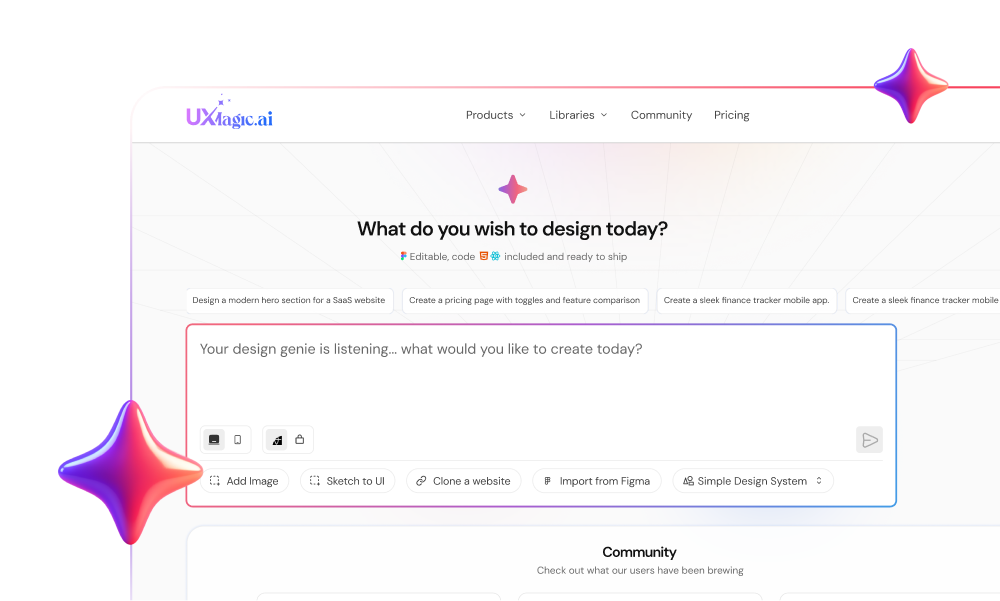
Feed system constraints into UXMagic and generate a white-label version of the interaction model. You preserve architectural credibility without exposing proprietary data.
That turns invisible experience into visible leverage.
Using AI to Generate Production-Ready UI Flows for Your UX Portfolio
Static portfolios signal execution.
Interactive flows signal systems thinking.
Hiring managers care about the second one
Showing Edge Cases Instead of Happy Paths
Most portfolios only show ideal journeys.
Senior portfolios show:
- error states
- empty states
- loading transitions
- fallback logic
Designing these manually across multiple flows takes days.
Generating them with structured prompts inside UXMagic proves architectural awareness in hours instead.
That difference is visible immediately.
Turning NDA Projects Into Proof Instead of Gaps
A fintech designer once lost access to a trading dashboard redesign that improved task completion by 40%.
Their portfolio suddenly looked junior.
By generating anonymized proxy tables with filtering logic, bulk actions, and modal states using UXMagic, they rebuilt visual credibility without exposing proprietary interfaces.
Same strategy.
New artifacts.
Callbacks returned.
Replacing Static Screens With Interactive Sequences
Flat PNG grids don’t communicate interaction governance.
Interactive flows do.
Embedding structured sequences instead of screenshots shows:
- state transitions
- component scaling
- logic consistency
- architectural intent
Your UX portfolio stops looking like documentation and starts looking like product thinking.
If accessibility states are part of your flows, this guide on prompting AI for WCAG 2.2–ready UI helps ensure those sequences remain credible signals instead of decorative ones: https://uxmagic.ai/blog/prompting-ai-wcag-22-accessible-ui
A strong UX portfolio in 2026 isn’t about showing prettier screens it’s about proving leverage fast. Compress your role, lead with impact, and replace missing artifacts with structured flows that show systems thinking instead of surface craft. That’s what gets interviews now.
Stop Optimizing Screens. Start Optimizing Signal.
The UX portfolio that gets interviews in 2026 isn’t prettier. It’s sharper, faster to scan, and brutally clear about impact.
Pick one case study today and rewrite the first screen so a recruiter understands your role, your constraint, and your outcome in five seconds. Then rebuild the missing flow that proves it.
Prediction: within 12 months, portfolios without interactive system-state evidence won’t just feel outdated they’ll look incomplete.
Rebuild Your Strongest Case Study in One Hour
Stop leaving NDA projects and missing flows out of your portfolio. Generate production-ready UI sequences with UXMagic and prove your systems thinking instantly.