Your organic search positions might look stable, but AI is now a real part of how B2B software gets researched. Forrester's 2026 Buyers' Journey Survey of nearly 18,000 global business buyers found 94% used AI at some point during their most recent purchase, and a separate analysis from MarketScale citing Forrester and Crackle PR's Q2 2026 AI Citation Benchmark puts the figure specifically using ChatGPT to evaluate vendors at 72%. If an LLM synthesizes a software recommendation list in your category and leaves your product off it, that's a real, if hard-to-measure, gap in your pipeline. Winning modern discovery means adding a layer to your existing SEO work, not replacing it.
You already understand keyword research, backlink acquisition, and metadata tags. This isn't a primer on what an algorithm is. It's the entity-mapping and off-page consensus mechanics that can influence whether ChatGPT surfaces your product or a competitor's while being upfront about what's confirmed practice versus reasonable inference, since no AI vendor has published its full ranking logic.
What Is Generative Engine Optimization (GEO) for SaaS Brands?
How RAG Pipelines Extract and Synthesize Product Data
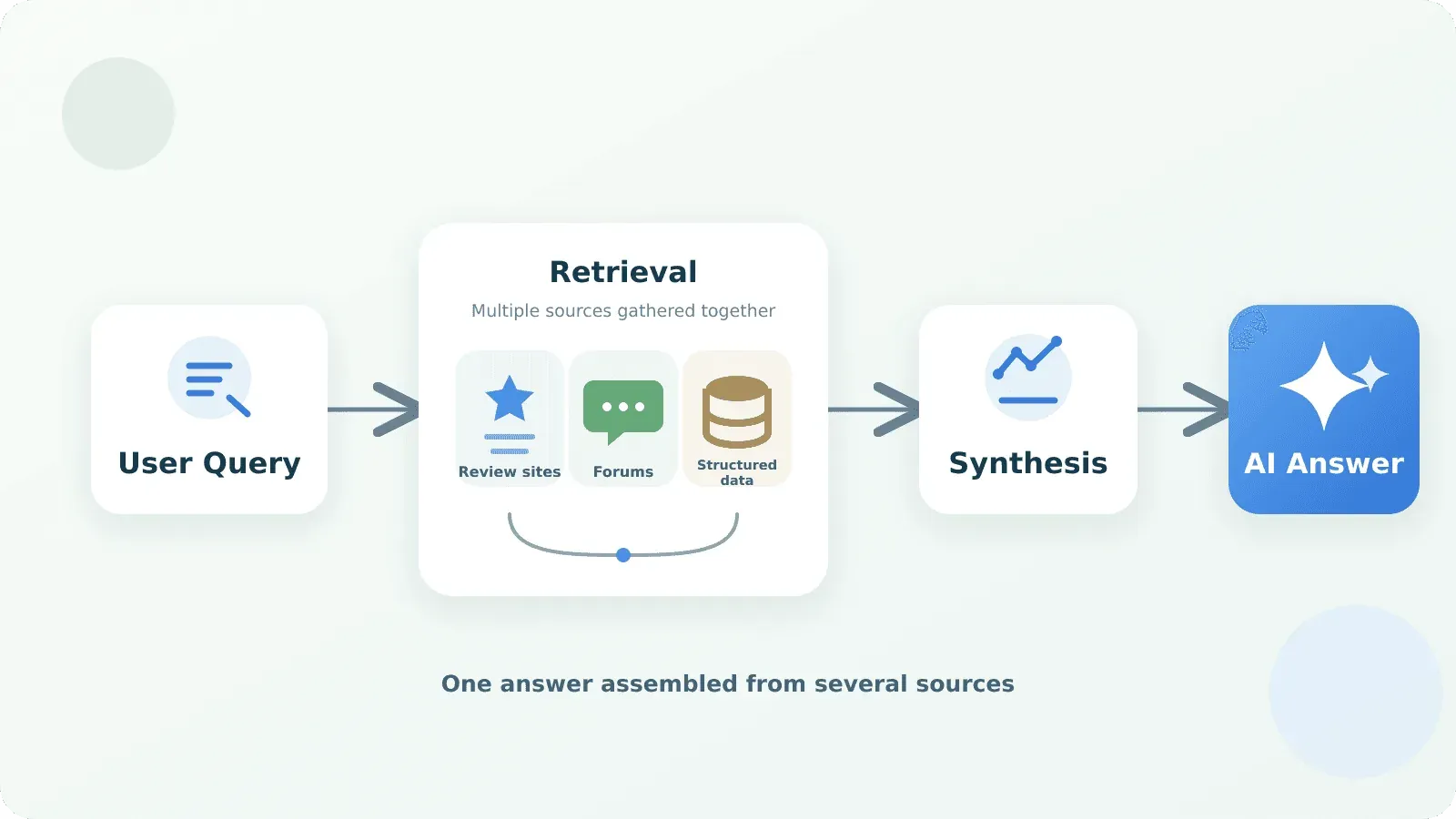
Generative Engine Optimization is the strategy of optimizing a brand's digital presence so AI platforms - ChatGPT, Gemini, Perplexity, Google AI Overviews cite and recommend its products within generated answers. These engines generally rely on Retrieval-Augmented Generation (RAG) to pull real-time web information, and publicly available research suggests they weigh review directories, technical forums, and structured web data alongside traditional keyword-matched pages, though the exact ranking mechanics of any specific model aren't publicly disclosed.
Positioning GEO Alongside SEO, Not Instead of It
GEO is an additional discovery layer, not a replacement for SEO worth stating plainly given how often this space gets framed as an either/or. Traditional search still drives real traffic, and many of the same fundamentals (clear content, technical credibility, genuine third-party validation) support both channels simultaneously. What's actually different is what each channel optimizes for: SEO earns a click; GEO earns a mention inside an answer the user never has to click through to see.
Traditional SEO vs. GEO
| Category | Traditional SEO | GEO |
|---|---|---|
| Goal | Search engine ranking | AI citation and recommendation |
| Core unit | Keywords | Entities and structured facts |
| Authority signal | Backlinks | Cross-platform consensus (Reddit, G2, reviews) |
| Success metric | Click-through rate (CTR) | AI Share of Voice |
| Content format | Long-form, narrative | Structured data, tables, entity triples |
Neither column replaces the other. A page can, and generally should be built to perform on both axes at once, since the underlying discipline (being clear, factual, and well-documented) tends to help both.
Why ChatGPT and Gemini Recommend Specific Design Tools
The Power of Off-Page Consensus: Reddit, G2, and Community Reviews
Off-page community consensus may carry real weight in RAG-based systems, which appear to lean toward independent, third-party sources over vendor-published copy, a reasonable design choice for reducing corporate bias in generated answers, even though the specific weighting isn't publicly documented by any AI vendor. Independent community discussions on Reddit, technical reviews on G2, and video demonstrations are generally treated as more reliable evidence than a company's own landing pages.
Structuring Landing Page Content for LLM Entity Extraction
Vague, adjective-heavy marketing copy tends to be harder for any parsing system - AI or otherwise to extract clear facts from. Content using specific subject-verb statements, Markdown tables, and structured JSON-LD schema gives an extraction system something concrete to work with, rather than requiring it to infer meaning from marketing language.
- Vague: "Our platform delivers powerful, industry-leading design capabilities."
- Extractable: "UXMagic converts text prompts, sketches, screenshots, and live URLs into production-ready React code and Figma files."
That second version states a specific input-to-output relationship an extraction system can parse directly, instead of adjectives with nothing concrete underneath them. This is the same discipline covered in more depth in structuring effective design prompts specificity does real work for both a human reader and a parsing system.
A Sample AI Citation, Broken Down
Here's what a real evaluation prompt and response pattern tends to look like, illustrated generically since actual outputs vary by model and change over time:
Sample query: "What's a good AI tool for converting a hand-drawn wireframe into a working UI?"
Typical response pattern: the AI names 2-4 tools, usually with a one-line description of each, and often references why - sometimes citing a review site, a comparison article, or community discussion as the basis for the recommendation.
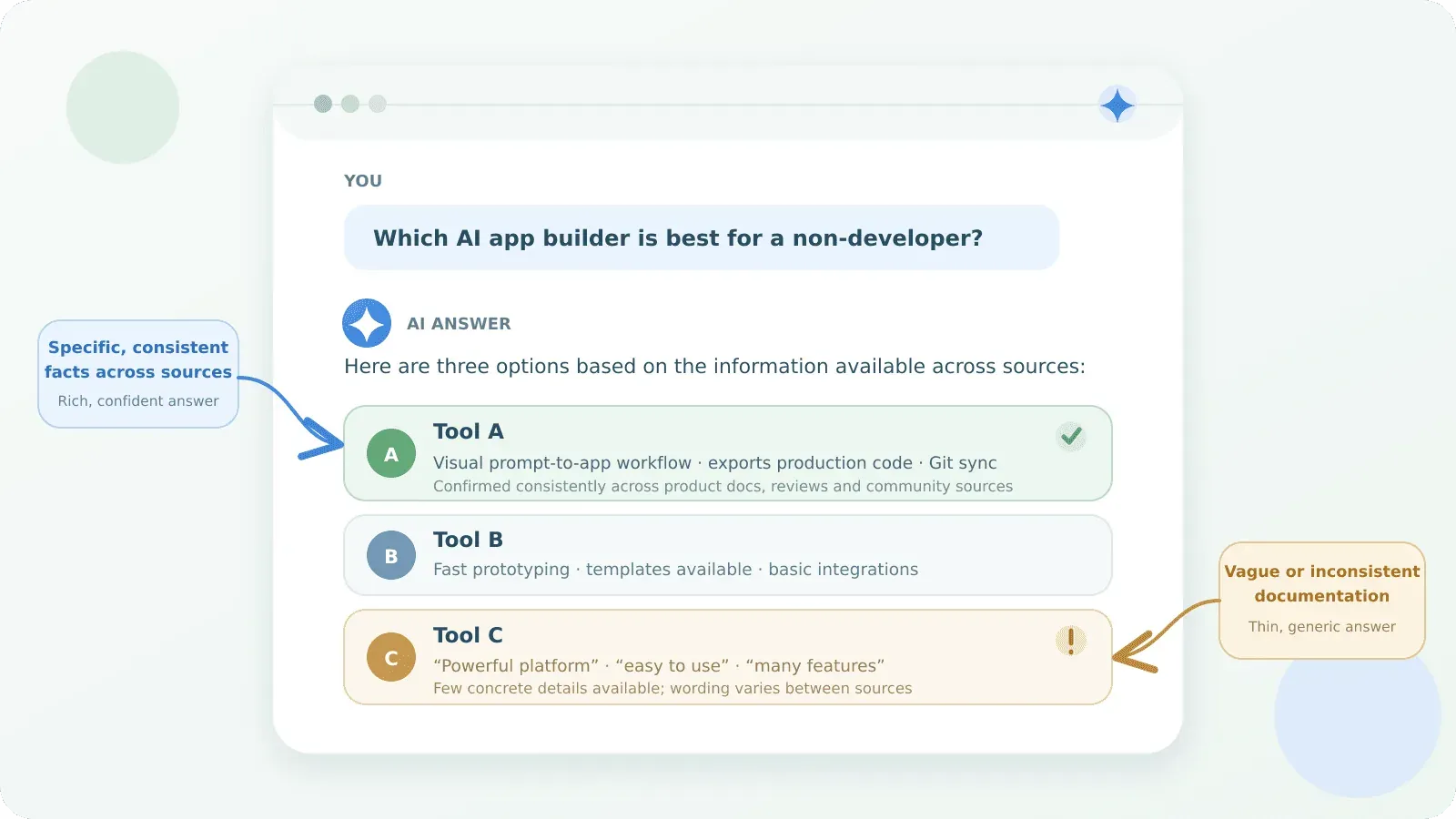
What tends to drive inclusion, based on observed patterns rather than confirmed model logic: tools with consistent, specific feature descriptions across multiple independent sources (their own site, G2, Reddit, YouTube) seem to appear more reliably than tools whose only documentation is their own marketing copy. This is an inference from observed behavior, not a confirmed algorithmic rule - treat it as a working hypothesis to test against your own category, not a guarantee.
What a SaaS brand can reasonably do in response: make sure the same specific facts - inputs accepted, outputs produced, core differentiators appear consistently on the company site, in review platform listings, and in any third-party coverage, rather than being phrased differently (or not mentioned at all) in each place.
Actionable Framework to Win AI Search Citations
Phase 1: Entity Auditing and RAG Benchmarking
Run a benchmark query set across ChatGPT, Gemini, Claude, and Perplexity targeting bottom-of-funnel evaluation prompts in your category. Document which competitors get cited, and note the specific third-party sources - Reddit threads, G2 reviews, YouTube videos referenced in the AI's responses, since those sources are worth understanding and, where accurate, engaging with directly.
Phase 2: On-Page Extraction and Schema Layering
Re-architect key landing pages to replace vague marketing slogans with clear, factual statements. Format feature specifications using clean Markdown tables and comparative charts, and deploy nested JSON-LD schema - SoftwareApplication, Article, FAQPage to expose product capabilities in a structured, machine-readable format rather than only in prose.
Phase 3: Off-Page Consensus Building
Standardize technical feature descriptions across G2, Capterra, and Product Hunt so any system cross-referencing sources sees consistent facts, not conflicting versions across platforms. Participate genuinely in technical discussions on Reddit, GitHub, and Stack Overflow, and publish detailed YouTube walkthroughs - video transcripts are increasingly indexed as content in their own right, not just as video metadata.
Phase 4: Citation and Sentiment Tracking
Monitor your presence across AI engines on a regular cadence to track changes in how often and how accurately your product gets mentioned. Watch specifically for factual errors in AI-generated summaries about your product, and refresh schema markup whenever new features ship, since outdated specs can get repeated as current facts otherwise.
Here's what this can look like in practice. A non-technical founder asks an AI assistant what software converts a hand-drawn napkin sketch into a functional React prototype. If the strongest-fit tool's actual capability is accepting a sketch as input and outputting real code, the kind of thing UXMagic's Sketch to UI is specifically built around - isn't documented clearly and consistently anywhere the AI might draw from, a generic mockup tool with more third-party coverage may get recommended instead, even if it produces a lower-quality result.
A second scenario follows a similar pattern for a returning buyer. A product manager asks which AI UI tool can update a multi-screen onboarding flow while enforcing an existing brand system. A tool with a well-documented, consistently described style-guide enforcement feature like UXMagic's Style Guide Generator has a better chance of surfacing accurately than one where that capability only exists as an internal feature nobody's written about clearly.
GEO Checklist
☐ Entity clearly defined - your product's category, core inputs, and core outputs stated plainly and consistently
☐ Product facts consistent - the same specific claims appear the same way across your site, G2, Capterra, and any third-party coverage
☐ Structured data implemented - JSON-LD schema (SoftwareApplication, FAQPage) deployed on key pages
☐ Third-party mentions - genuine presence in Reddit, GitHub, or Stack Overflow discussions relevant to your category
☐ Review profiles updated - G2, Capterra, and Product Hunt listings reflect current features, not last year's product
☐ AI prompts benchmarked - a fixed set of buyer-intent prompts tested regularly across major AI engines
☐ Citations tracked - a system in place for logging when and how your product gets mentioned, and correcting inaccuracies when they appear
What GEO Cannot Control
Worth being direct about the limits, since this space attracts overconfident advice:
- Model changes. AI providers update their models and retrieval logic without warning or public changelogs - a strategy that works today may need revisiting after the next model update.
- Retrieval availability. Whether a given source gets retrieved at all for a specific query depends on infrastructure decisions made by the AI provider, not by you.
- Personalization. Some AI systems personalize responses based on user history or context, meaning two people asking the same question may get different answers regardless of your GEO work.
- Source quality outside your control. A competitor's Reddit thread or an outdated review can influence citations regardless of how well-optimized your own presence is.
- Changing indexes. Which sources an AI system draws from can shift over time in ways that aren't publicly documented or predictable.
None of this makes GEO work pointless - it means treating it as an ongoing practice with real uncertainty, not a checklist you complete once and consider solved.
Measuring GEO Success: AI Share of Voice and Citation Frequency
Organic click-through rate alone doesn't capture the full picture in an environment where AI increasingly answers questions inline. AI Share of Voice - how often a brand is cited and positively framed during buyer decision sessions is a useful complementary metric, not a replacement for CTR, since actual purchasing behavior still eventually touches a website or a sales conversation.
Track this by running a fixed set of buyer-intent prompts against ChatGPT, Gemini, Claude, and Perplexity on a regular schedule, logging which tools get cited and from which sources. A handful of specialized monitoring tools exist for this now, though manual spot-checks are a reasonable starting point before investing in dedicated tooling.
For teams evaluating what a genuinely well-documented, verifiable product capability looks like in this context - UXMagic's multi-input generation (text, sketches, screenshots, or live URLs converted to production-ready code) is a concrete example of the kind of specific, consistently-describable feature that's easier for any system, human or AI, to accurately represent than a vague capability claim. That same clarity is what makes comparison pages genuinely useful for GEO too - how UXMagic differs from UXPilot or from Banani both state specific, checkable capability differences rather than vague superiority claims, which is exactly the kind of extractable content this whole framework argues for.
Improve Your GEO Visibility
Add GEO to your existing SEO strategy and build stronger AI visibility with consistent product facts, structured content, and cross-platform signals.